In 2012 I spent some time at the University Medical Center Groningen, in Rob Coppes’ lab, and somewhere between the cell culture hoods and the coffee machine there was a poster on the wall that I liked enough to photograph. It was not a pretty poster, just a list of six questions in a plain font under a slightly grand title: “Van Zant’s Six Cardinal Questions of Scientific Investigation.” I took the picture, filed it away, and then proceeded to think about those six questions on and off for the next fourteen years, which is more than I can say for most things I photographed that year.
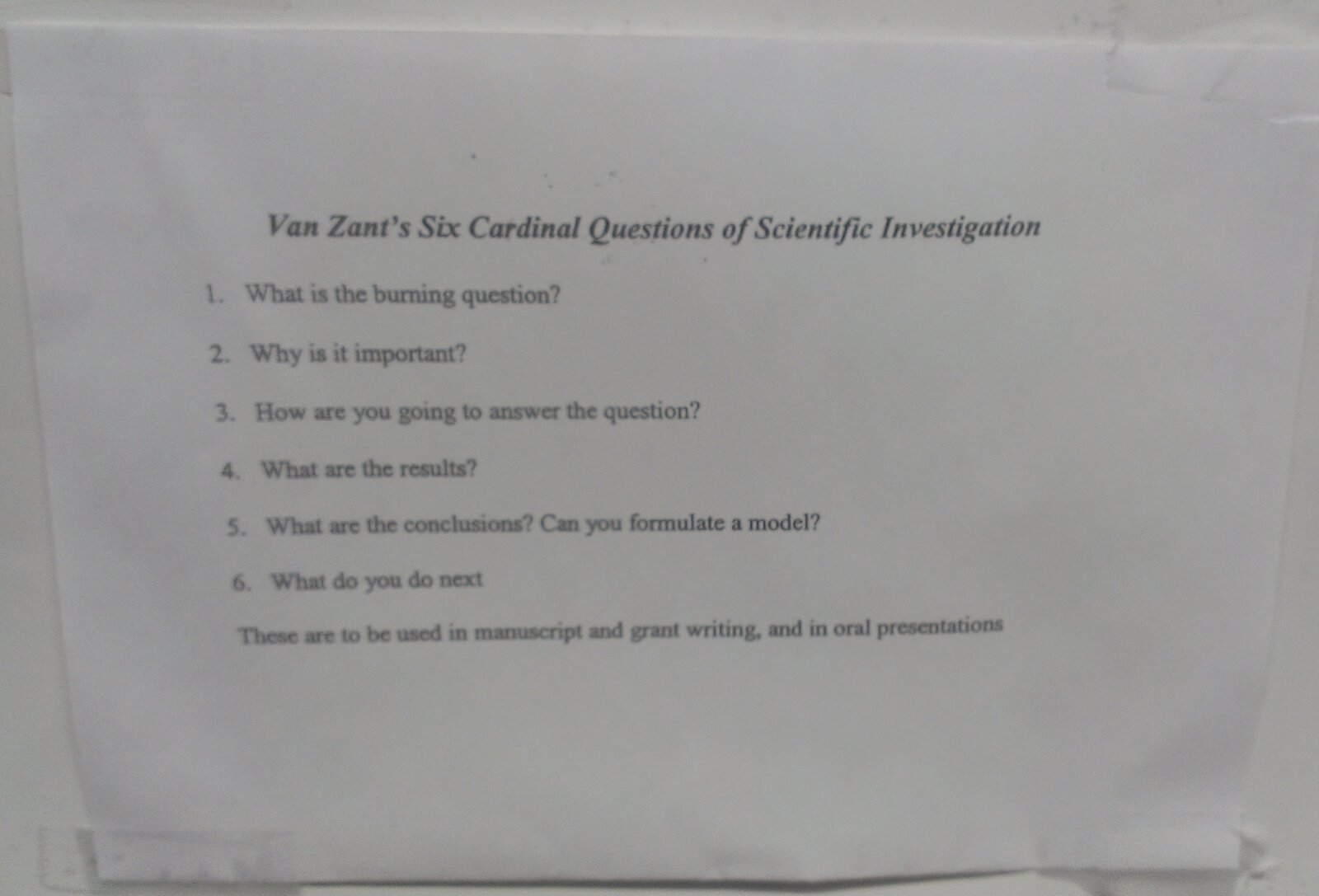
The six questions
Here they are, exactly as the poster had them:
- What is the burning question?
- Why is it important?
- How are you going to answer the question?
- What are the results?
- What are the conclusions? Can you formulate a model?
- What do you do next?
And underneath, in smaller print, the instruction that turns the list from a philosophical musing into something operational: “These are to be used in manuscript and grant writing, and in oral presentations.”
That last line is the part people tend to skip over, and it’s the part that makes the whole thing work. This isn’t a poster about the nature of scientific truth. It’s a poster about how to explain yourself to other people without wasting their time.
It’s IMRAD, sharpened to a point
If you’ve written a paper, you’ll recognise the skeleton immediately: Introduction, Methods, Results, and Discussion, the structure that has organised scientific communication for roughly a century. Questions one and two are your introduction, question three is your methods section, four is results, five is the discussion, and six is that slightly awkward final paragraph where you gesture at future work.
So on one level the six questions are nothing new, and I think that’s precisely why they’re useful. IMRAD as a section list tells you where to put things. It does not tell you whether the things you’re putting there are any good. You can write a technically flawless introduction that never once states what you actually wanted to know, and I have read a great many of them, and I have almost certainly written a few myself. The six questions close that loophole by refusing to let you hide behind structure, because a question demands an answer in a way that a heading simply does not.
The word “burning” is doing an enormous amount of work in question one. Not “the research question,” not “the objective of this study,” but the burning question, the one where somebody actually cares about the answer. If you find yourself unable to phrase your work as a burning question, that’s diagnostic information, and it usually means either that you haven’t understood your own project yet or that the project doesn’t deserve the grant money. Both are worth knowing before the reviewers find out for you.
Question five has a similar sting in its tail with “can you formulate a model?” It’s not enough to say what the data showed. You’re being asked whether you understood it well enough to build something predictive out of it, which is a much harder bar and one that a surprising number of discussion sections quietly decline to clear.
Who on earth is Van Zant?
Naturally I went looking, because a poster that confidently attributes six numbered questions to a surname invites the question of whose surname it is. The honest answer is that I can’t prove it, but the trail is fairly convincing.
There is no published paper called “The Six Cardinal Questions,” no textbook chapter, no framework with a citation you could drop into a reference list. It appears to be exactly what it looks like: lab lore, the kind of thing a senior scientist says often enough that somebody eventually prints it out and sticks it on a wall.
The most likely Van Zant is Gary Van Zant, a stem cell biologist and haematologist at the University of Kentucky, known for his work on the ageing of haematopoietic stem cells. The reason I think it’s him and not some other Van Zant is the geography. Van Zant had a long-running collaboration with Gerald de Haan at the UMCG, who worked on the same problem of stem cell ageing, with joint publications going back to around 1999. De Haan sat in the Department of Cell Biology in Groningen, and so did Rob Coppes, whose lab works on radiobiology and adult stem cells of the salivary gland. Same department, overlapping subject matter, a visiting collaborator with strong opinions about how to write a grant. You can more or less watch the poster travel down the corridor.
I want to be clear that this is a plausible reconstruction and not a documented fact. But it’s a nice illustration of how institutional culture actually propagates, which is not through frameworks and training decks but through somebody saying a useful thing repeatedly until it ends up laminated.
Why I still use them, fourteen years and one career change later
I left the bench a long time ago and now spend my working life in IT consulting for life sciences companies, which involves approximately zero manuscripts and a great deal of proposals, concepts, workshop summaries, and slide decks that need to convince somebody of something. The six questions survived the transition almost completely intact, and I’ve come to think that’s because a grant application and a consulting proposal are the same document wearing different clothes. Both are asking someone to hand over money for work that hasn’t happened yet, on the strength of your ability to explain why the problem matters and why you’re the one who should solve it.
Run a proposal through the list and the weak spots surface fast. What is the burning question turns into what is the client’s actual pain, which is a question that a startling number of proposals answer with a description of a technology instead. Why is it important turns into what happens if they do nothing, and if the answer is “not much,” you have learned something important about your pipeline. How are you going to answer it is your approach, and question six, what do you do next, is the one that separates a proposal from a plan.
The same applies to internal work. Before a workshop, “what is the burning question” is a far better framing than “what is the agenda,” because an agenda is a list of topics while a burning question is a reason for eight people to be in a room. Before a status report, question five is an excellent filter: you have the results, but can you formulate a model, meaning do you actually understand what’s going on well enough to predict what happens next? If not, say so, but say it deliberately rather than by omission.
The point
What I like most about the six questions is how unimpressed they are with themselves. There’s no maturity model, no quadrant, no acronym, just six sentences that take thirty seconds to read and are quietly ruthless about whether you know what you’re doing. Most of the frameworks I encounter professionally have considerably more slides and considerably less content.
So here’s my suggestion, and it costs you nothing. Take whatever you’re currently writing, whether it’s a paper, a proposal, a project charter, or an email you’ve rewritten four times, and answer the six questions on a piece of paper before you touch the document again. If you can answer all six crisply, the writing gets easier because you already know what you’re saying. If you can’t, you’ve just found out why the document was fighting you, and no amount of rewriting the introduction was ever going to fix it.
Somewhere in Groningen there may still be a poster on a wall making that point better than I just did in fifteen hundred words. That’s lab lore for you.